01
+
Visit MCX.center
Come in, explore the portfolio and spend time with the technology in person at our Experience Centre in Barsha Heights.

Founded in 1998 by Bob Bauman and David Hoatson in Costa Mesa, California. Lynx Studio Technology builds converters and interfaces for engineers who cannot afford colouration — mastering suites, broadcast facilities and studios where the signal must be reproduced exactly.
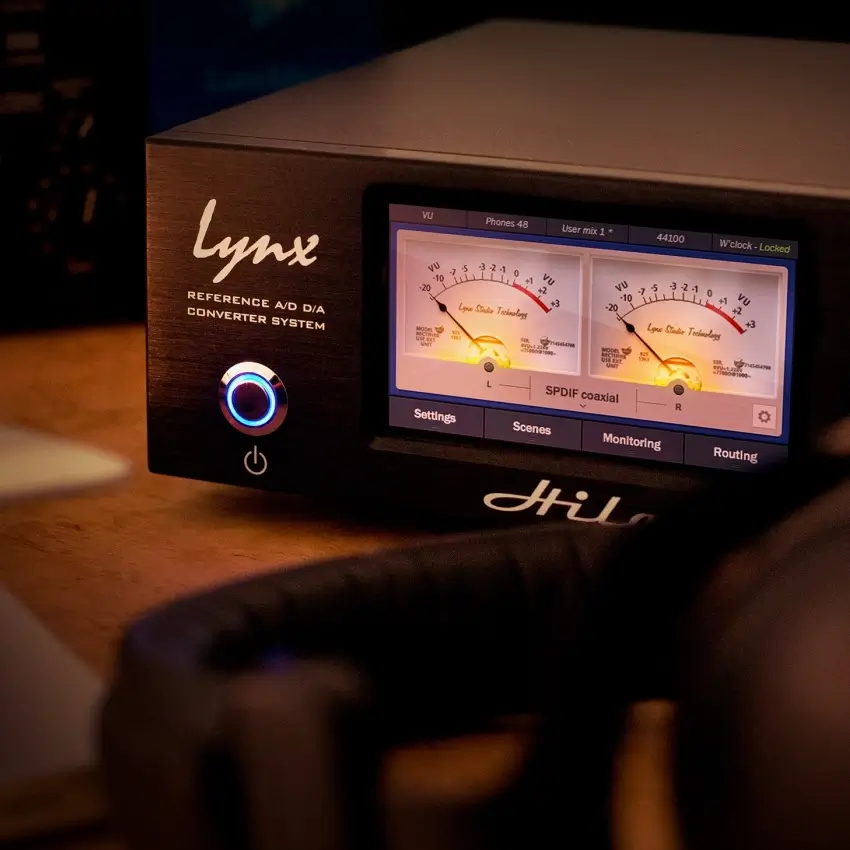
Lynx Studio Technology was founded in Costa Mesa, California in 1998 by Bob Bauman — a hardware engineer who designed Class H amplifiers, preamps and equipment for NASA — and David Hoatson, a software engineer with 30 years of driver and firmware expertise. Their shared obsession: perfect transparency between the analogue world and the computer.
Over more than 25 years, Lynx converters have been selected by mastering engineers, broadcast facilities and mixing rooms that regard colouration as a defect rather than a feature. The Aurora(n) — in 8, 16, 24 and 32-channel formats — has become a reference-grade standard in professional installations worldwide. The Hilo 2 is the mastering engineer's monitor controller and converter of choice. The Mesa, launched in 2025, brings Aurora-grade conversion into a compact Thunderbolt 3 desktop form factor for the first time.
Available across MENA and Türkiye through MediaCast — authorised distributor, stock held in Dubai, with demonstrations at the MCX Experience Centre in Barsha Heights.
The Mesa brings Lynx's reference-grade conversion to a compact desktop form factor for the first time — four microphone/line/Hi-Z inputs, dual headphone outputs with independent D/A converters, and the same capacitive touchscreen as the Hilo 2. The MicroSD card slot enables standalone recording without a computer. A high-contrast IPS display, Aurora-identical preamps, and Thunderbolt 3 connectivity make it the obvious choice for the serious project studio or location recordist who demands Lynx quality outside the rack.

Four mic/line/Hi-Z combo inputs — identical circuitry to the Aurora(n) LM-PRE4. High-contrast IPS capacitive touchscreen, dual headphone outputs with independent D/A and level controls, MicroSD slot for standalone recording. 14 total I/O with 2 loopback channels. Compatible with Mac and Windows.
The original Hilo defined expectations for mastering-grade AD/DA conversion at its price point in 2012. The Hilo 2 raises that standard significantly — lower distortion, lower noise, SynchroLock 2 at 7ppm absolute accuracy, an upgraded IPS capacitive touchscreen with significantly greater brightness and off-axis uniformity, and selectable linear and minimum phase filters on all I/O. The LSlot expansion accepts Thunderbolt, USB and Dante cards — one unit, every connectivity scenario, without replacing the hardware.

Independently coupled 2-input, 6-output AD/DA converter with digital expansion up to 16×16. SynchroLock 2 clock system. Selectable linear and minimum phase filters. High sample rate upgrade path to DSD and beyond 192kHz. The reference choice for mixing, mastering and professional monitor control.

The LSlot card system makes the Hilo 2 future-proof. Thunderbolt 3, USB and Dante LSlot cards allow the same unit to serve a Thunderbolt Mac studio today, a Dante broadcast chain tomorrow, and a USB Windows workstation the year after. No planned obsolescence — a card swap, not a hardware purchase.
The Aurora(n) is a complete redesign of the original Aurora — one of the most widely installed professional converters ever made. Available in 8, 16, 24 and 32-channel configurations in a 1U rack format. An onboard 32-channel MicroSD recorder enables direct recording and playback without a computer. The LSlot system accepts Thunderbolt, USB, Pro Tools HD and Dante cards, while the module bay accepts mic preamps, digital I/O and additional analogue I/O. A converter that grows with a facility.

Eight channels of Lynx AD/DA in 1U. Onboard 32-channel MicroSD recorder. LSlot expansion for Thunderbolt, USB or Dante. Module bay for mic pre and digital I/O expansion. The entry point for a professional Lynx system that scales to 32 channels without a new converter.

Sixteen channels in 1U — the most common configuration in professional recording and mixing studios. Module bay for LM-PRE4 mic preamps or LM-DIG AES/EBU digital I/O. Supports Dolby Atmos via free firmware update. The centre of a professional studio conversion chain.
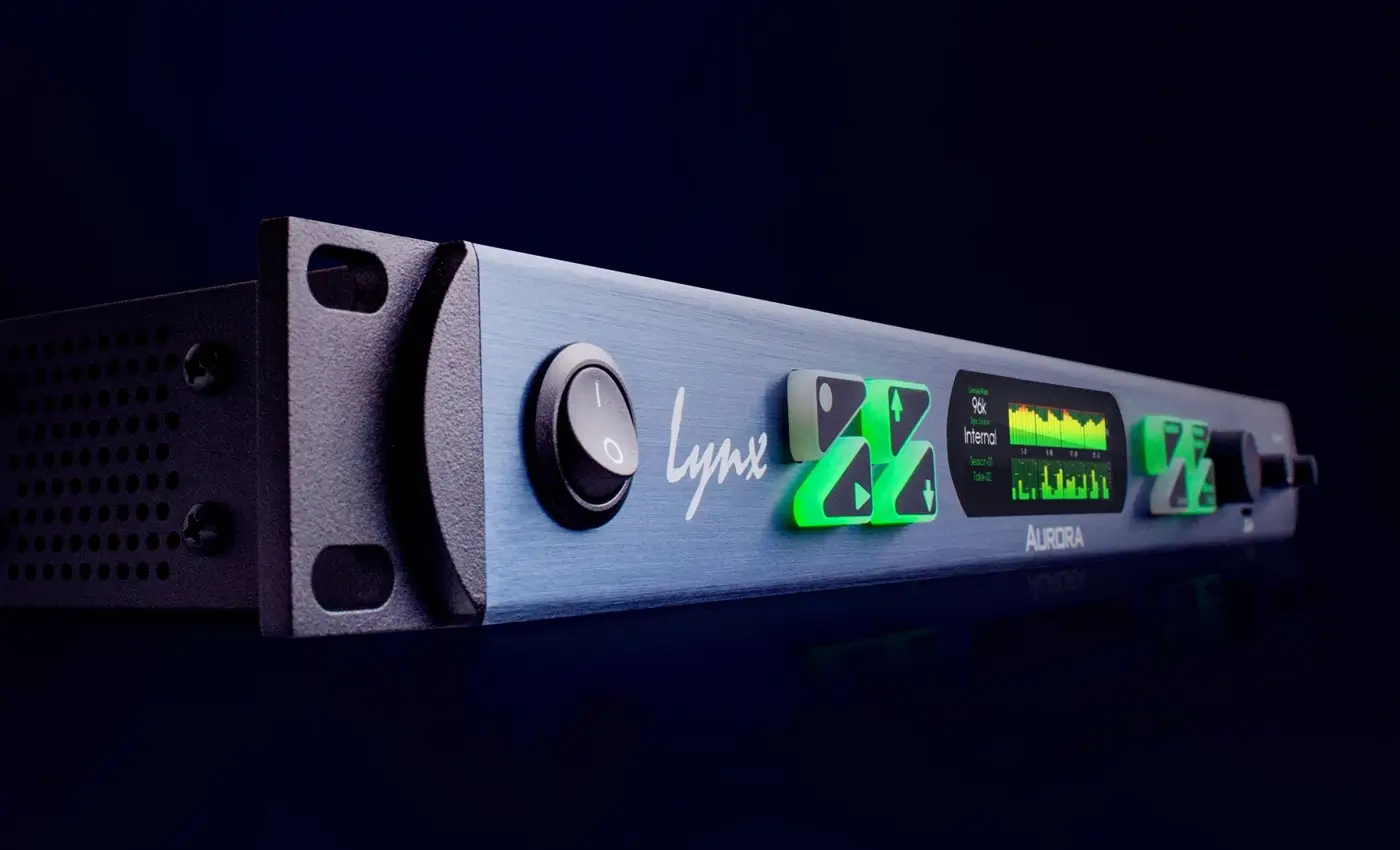
Twenty-four and thirty-two channel configurations for large studios, broadcast facilities and post production suites. The Aurora(n) 24 with Thunderbolt 3 is the most widely deployed Lynx unit in professional facilities globally. Dolby Atmos-ready in a single 1U unit.
Lynx PCIe cards bring reference-grade AD/DA and AES/EBU I/O directly inside workstation towers — no external converter box, no Thunderbolt cable. For studios built around high-channel-count workstations where internal expansion is preferred, PCIe cards deliver the lowest possible latency with the same Lynx conversion quality in a permanent installation.

Sixteen channels of AES/EBU I/O in a single PCIe card. Optional sixteen-channel sample rate converter at 144dB dynamic range and ‑140dB THD+N. Extensive onboard digital mixer handles routing without touching the host CPU. The digital backbone for large broadcast and post facilities.
Aurora(n) modules slot into the unit's expansion bay to add capabilities without buying a new converter. Mic preamps, AES/EBU digital I/O, ADAT optical and additional analogue I/O are all available as modules — an 8-channel Aurora(n) can become a 16-channel system with mic preamps and AES/EBU connectivity through progressive expansion.
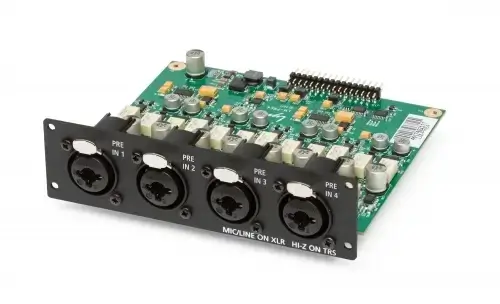
Four-channel mic/line/Hi-Z input module for the Aurora(n). On-board A/D conversion directly coupled to the preamp output — four additional input channels with Lynx's transformerless, transparent design. The same preamp circuit used in the Mesa.

The LM-DIG adds sixteen channels of AES/EBU I/O on two 25-pin D-sub connectors. Paired with the DB-ADAT daughter board it adds four ADAT optical connections plus S/PDIF — covering every common digital interconnect in a single module pair.

The LM-A24 adds four electronically balanced TRS outputs with 0.5dB increment level control up to +24dBu. The LM-AIO8E adds eight channels of analogue I/O on DB-25. Both expand the Aurora(n)'s analogue channel count without an additional converter unit.
Lynx products are specified by engineers who have measured their actual performance and compared them. These are the measurable, verifiable differences.
Lynx's second-generation clock system tracks external word clocks with faster locking and measurably less jitter than first-generation designs. At 7ppm, phase drift across large sessions and multi-unit systems is minimised in a way that measurements confirm and listening tests rarely reveal.
Lynx products are engineered for signal transparency — the output is the input, reproduced as accurately as physics allows. There is no deliberate harmonic character, no transformer colouration, no circuit personality. For mastering, this is a prerequisite rather than a preference.
LSlot expansion cards let you change connectivity without replacing the converter. A Hilo 2 or Aurora(n) with a Thunderbolt card today can become a Dante broadcast unit, a USB Windows workstation, or a Pro Tools HD facility — with a card swap, not a hardware purchase.
The Aurora(n) and Mesa both include a MicroSD slot for 32-channel direct recording and playback. Primary recorder, backup system, or standalone archive — no computer required. Directly useful for location recording and facilities requiring a dedicated backup chain.
Both the Hilo 2 and Mesa feature a high-contrast IPS capacitive touchscreen. Mixer routing, monitor control and level adjustments are all accessible from the front panel without software, at full conversion quality. Upgraded on the Hilo 2 for significantly greater brightness and improved off-axis viewing.
Lynx converters receive free firmware updates that add capabilities — the Aurora(n) Dolby Atmos update, Hilo 2 high-sample-rate expansion and new filter options have all been free. A Lynx converter improves over time rather than becoming obsolete.
Lynx converters are specified when engineers conclude that colouration is unacceptable — in mastering, broadcast, post, and high-resolution archiving.
Hilo 2 or Aurora(n) 8–16 as the reference converter and monitor controller. SynchroLock 2 clocking and selectable linear/minimum phase filters for sessions where inter-sample accuracy and dithering demand the most transparent analogue reproduction available.
Aurora(n) 16 or 24 with LM-PRE4 mic pre modules for tracking sessions. Up to 32 channels in 1U, with onboard MicroSD as a backup recorder — a complete input chain in a single rack unit.
Aurora(n) with AES16e PCIe cards and Dante LSlot for broadcast facilities requiring high channel counts, word clock synchronisation and the lowest colouration on voice and music signal chains.
Aurora(n) 24 or 32 with free Dolby Atmos firmware for immersive mixing suites. AES/EBU and Dante for multi-room post facilities. LSlot accommodates Pro Tools HDX where required.
Hilo 2 with DSD upgrade for archiving workflows. Vinyl rips, tape-to-digital transfers and national archive institutions choose Lynx for its measurable accuracy and precision clocking.
Mesa or Hilo 2 on location — compact, Thunderbolt-connected, with onboard MicroSD as a primary or backup recorder. The same conversion quality as the fixed studio installation, without compromise.
Joel is MediaCast's specialist for Lynx Studio Technology — handling every enquiry across MENA and Türkiye. He's specified Lynx systems for mastering suites, broadcast facilities, post production rooms and professional recording studios across the region.
Specialises in professional converters, interfaces and studio system design. Handles Lynx Studio Technology, Universal Audio, IK Multimedia, MOTU and Apogee across MENA and Türkiye.
Start wherever it feels easiest. Visit us, message us, call us or send the details through. We will guide you to the right person and the right next step.
Come in, explore the portfolio and spend time with the technology in person at our Experience Centre in Barsha Heights.
Explore MediaCast's online store for professional technology, trusted brands and expert support whenever you need it.
Tell us what you are working on. We will help shape the right route, with clear options, pricing and next steps.
Need a quick answer? Reach out for product advice, availability checks or simply a helping hand from the team.
Prefer to speak to someone? Give us a call and we will connect you with the right person.
For quotations, project discussions and anything that deserves a more detailed conversation.